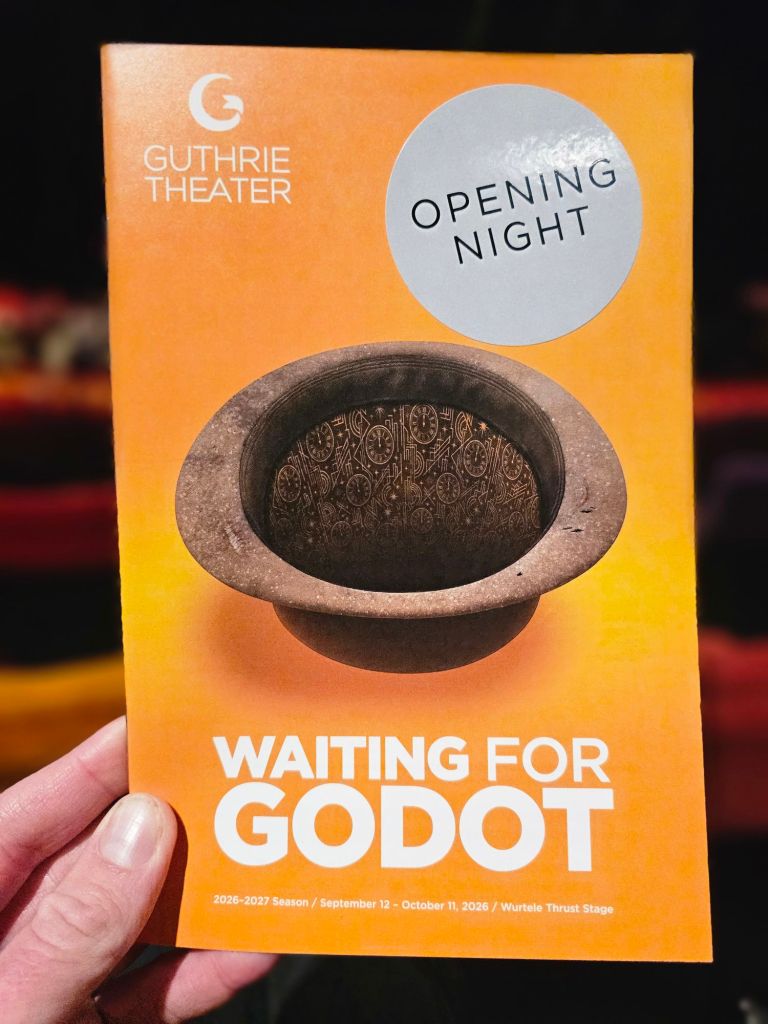
Waiting for Godot by Harold Pinter is one of the quintessential pieces of absurdist theatre, a genre I’m not typically all that fond of. In the wrong hands, absurdist and surrealist humor can come across as opaque and self-indulgent without having much to say. Thankfully, due to the strong directorial hand of Joseph Haj and lively performances of David Strathairn, Jimmy Kieffer, Will Sturdivant, and Jim Lichtscheidl, the Guthrie’s production makes the classic tragicomedy not just entertaining but also accessible – this is one of the funniest plays about despair you’re likely to see.
By now, the basics of the story of Godot are fairly well known – two down-on-their-luck tramps, Estragon (Kieffer) and Vladimir (Strathairn), meet up to sit by a tree on a roadside and wait for the arrival of Godot, a man they’re convinced will change their fortunes. Why and how he’s going to do so, precisely when he’s going to arrive, or even exactly who he is are unknown to them, but they wait nonetheless. As they wait they make conversation – or have arguments, really. Vladimir is more chatty which sometimes annoys the more stoic Estragon. Memories, tight boots, carrots, turnips, and any number of other topics weave in and out of the conversation, but it always comes back to the topic of waiting for Godot. Why is he the one they’re waiting for? Because they have to wait for him. Why is he worth waiting for? Because they decided he is. If those non-answers seem frustrating to read, they’re even more so for Vladimir and Estragon to live, and on a number of occasions throughout the play’s runtime the two men muse on the possibility of suicide, perhaps by hanging themselves from the tree that’s been there all along. But, of course, suicide is far too easy a way out for characters in a situation like this, and when they can’t make that work they just have to wait some more.
This is my second experience with Godot – I previously saw the 2023 off-Broadway production starring Michael Shannon and Paul Sparks, and as much as I loved the performances the show still felt fairly opaque to me. Shannon and Sparks felt like they were deliberately playing contrasts, with Sparks playing Vladimir like a wounded puppy while Shannon’s Estragon was mostly deadpan and stoic. Here, Strathairn and Kieffer don’t seem so different – the humor and deadpan wit comes from both of them in equal measure, and as a result the show feels much more alive. Strathairn on TV and film often finds himself cast as forthright authority figures, and if that’s how you’re used to seeing him you may be shocked by how funny he is here. He and Kieffer (adding yet another classic comedic Guthrie performance to his resume, following his delightful work as Puck in A Midsummer Night’s Dream and Falstaff in The History Plays) play off each other beautifully, giving a real sense of connection between them. Even more energy comes from the arrival of Ponzo (Will Sturdivant) and Lucky (Jim Lichtscheidl), who arrive just in time to gloriously illustrate the (il)logical extreme of the two tramp’s discussions about men who are kept at the mercy of other men. Sturdivant just about steals the whole show with his flamboyant performance as the colorfully-coiffed, whip-wielding Ponzi who dominates the leashed Lucky while also seeming to share a strange sense of codependency with him… he’s constantly yelling for Lucky to do things for him, but we later see how that’s largely because he can’t actually do much of anything on his own. As Lucky, Lichtscheidl has a showcase monologue in Act 1 that somehow seems to cover every topic that anyone has ever discussed, and the verbal and physical dedication he brings to it goes from absurd and funny to almost frightening.
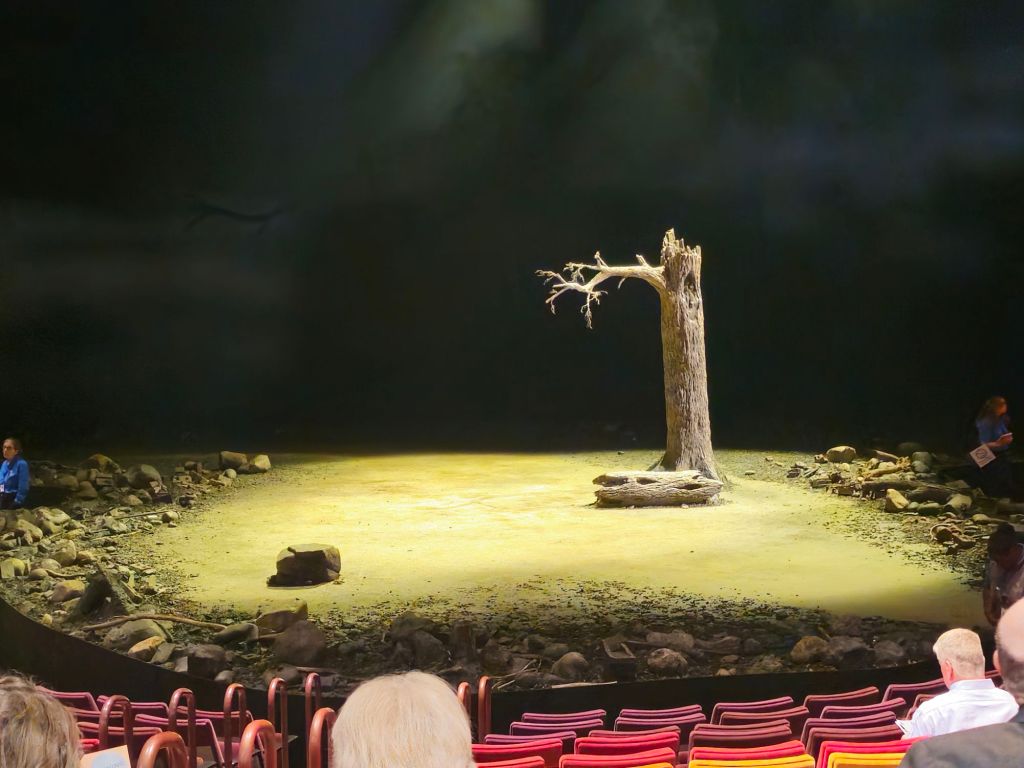
The set design by Marion Williams is stark but effective, as is Christopher Akerlind’s lighting. Both highlight the whole space of the Wurtele Thrust Stage that both showcases the emptiness of the characters’ lives and gives them plenty of room to engage in very funny sequences of physical comedy. Director Haj realizes that it is moments of humanity and humor like those that give the play life in spite of the bleakness at its center, but he also understands they wouldn’t come through if the performances were not believable. It’s a testament to his direction that he is able to keep the tone in a proper balance, largely by highlighting the humanity of the central characters. After all, Vladimir and Estragon aren’t just waiting for Godot, they’re waiting with each other. Whenever one of them begins to feel overwhelmed by the absurdity and hopelessness of the situation they’re in, it’s their connection to the other that gives them the motivation to keep on going. That’s both the tragedy and comedy of this tragicomedy – you might be spending what’s left of your life waiting for someone who will never come, but at least you’re not waiting alone.
WAITING FOR GODOT plays at the Wurtele Thrust Stage at the Guthrie Theatre through October 11th.
 Friends and Neighbors
Leave a comment