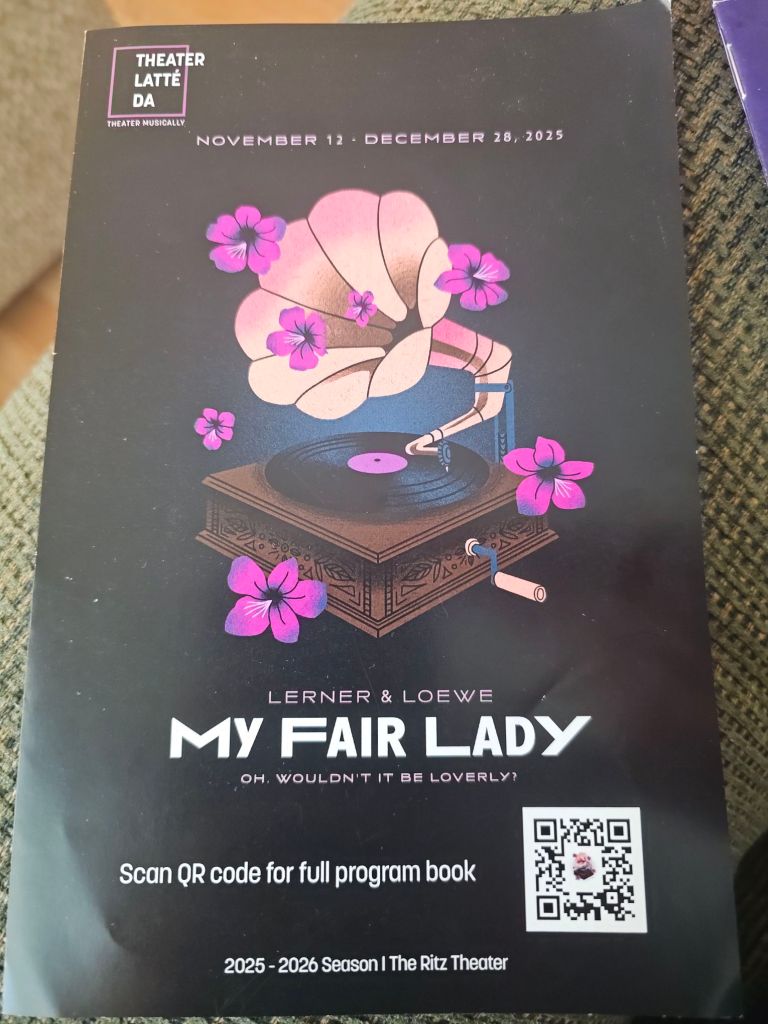
Theatre Latte Da continues their streak of smartly produced and impeccably acted interpretations of beloved musicals with My Fair Lady, a new production of Lerner & Lowe’s classic musical adaptation of Pygmalion. Director Justin Lucero brings a light touch that keeps the comedy moving quickly, but also knows when to slow down, allowing the characters to speak their minds whenever the show calls for it. My Fair Lady is a very funny musical, but Lucero and his cast also understand is has real things to say about identity & class and gender dynamics that are just as relevant today as they were in the Edwardian era where the show was originally set.
Of course, any production of My Fair Lady lives and dies on casting, and this one has hit it out of the park. As Henry Higgins, Jon-Michael Reese gives one of the most delightful comedic performances I’ve seen in a long time. He positively vibrates with energy, seeming to bounce back and forth across Eli Sherlock’s set as Higgins formulates his plan to pull one over on London’s upper crust. Matching him beat for beat is Anna Hashizume as Eliza Doolittle. Hashizume, coming straight off her show-stealing performance as Rizzo in the Chanhassen Dinner Theatre’s Grease, brings the same energy as a tough, self-assured woman who is both smarter and more vulnerable than she initially appears. The battle of wits between these two headstrong personalities is the heart of any production of My Fair Lady, and you can feel the fun the actors are having as Higgins tries to reshape the lower-class flower girl Eliza into a Lady, while Eliza tries to make it through Higgins’ lessons without losing herself to them.
And if those two weren’t enough on their own (and they would be), My Fair Lady also has a slew of delightful supporting characters, all of whom are cast terrifically. The always reliable Tod Peterson plays Colonel Pickering, a more warm and personable contrast to Higgins’ detached and self-centered approach. Adán Varela as Eliza’s father Alfred Doolittle is a delightful oaf, drifting from pub to pub and living off of what he can grift from others because, as he puts it, he “can’t afford” morals and is perfectly content that way. Then on the other side of the class divide we have Norah Long as Henry Higgins’ mother, who is perhaps even more exasperated by him than Pickering and Eliza. When Higgins brings Eliza to his mother’s box at the Ascot races in his first test to see if she can pass herself off as a Lady, Eliza instead manages to ingratiate herself by allowing her real personality to come through. Hashizume’ comedy chops really shine in these scenes, and we can see why the young aristocrat Freddy Eynsford-Hill (Felix Aguilar Tomlinson) immediately becomes drawn to her. In fact, it soon becomes clear that Eliza is more welcome in these circles than Henry himself, whose coarse personality and arrogance immediately turn people off. It’s another way the story illustrates the artificial nature of the class divide – when something as simple as an accent keeps people apart who might otherwise enjoy each others’ company, of what use is the barrier?
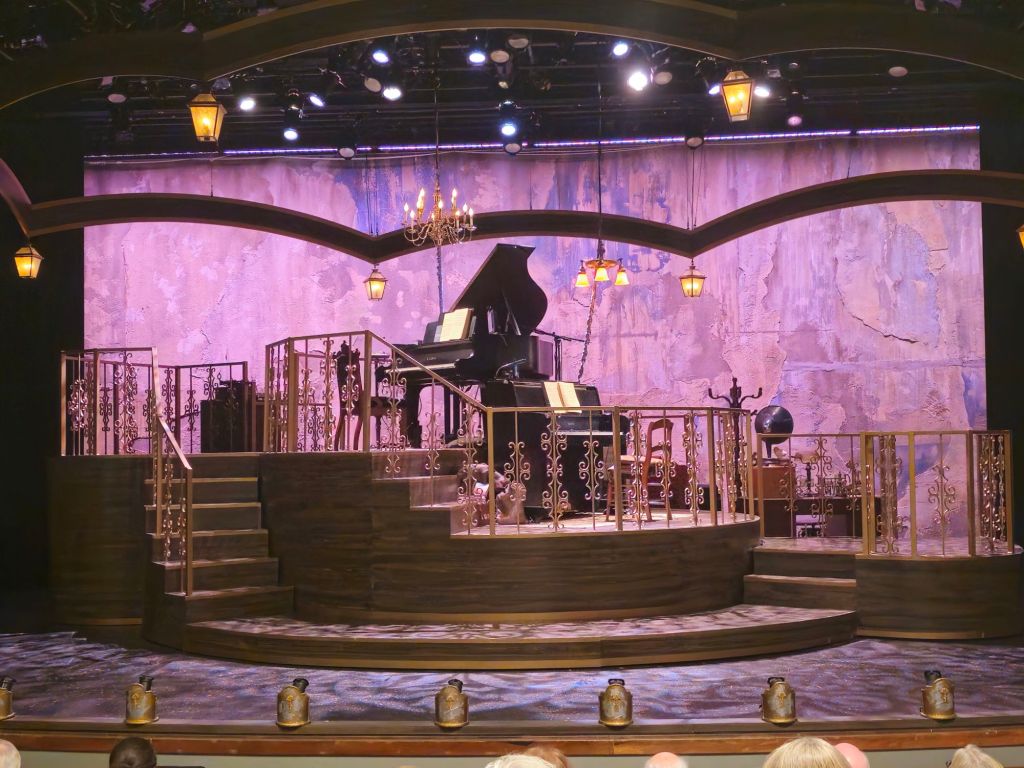
Class distinctions are felt at every layer in this production – even the instrumentation! The music in this production was newly arranged for two pianos by Trude Rittman, with conductor Joshua Burniece in formalwear playing on a grand piano while Wesley Frye wears more casual dress on a smaller piano. Both musicians are on stage for the entire show, sometimes even interacting with the cast. It’s an inspired choice, and one that shows a smart director can always find new ways to showcase a musical’s ideas, even into the music.

And what music! My Fair Lady contains some of the catchiest and most enjoyable songs in the classic musical theatre catalogue. Anna Hashizume gets to show off her range, from the more conventional “Wouldn’t it be Loverly” (which is, indeed very lovely) to breaking out her operatic voice for “I Could Have Danced All Night”. Jon-Michael Reese throws himself into a series of solos like “I’m an Ordinary Man” and “A Hymn to Him” that sometimes play more as soliloquies than songs but allow him to use every tool from his comedic toolbox to great effect, and Felix Aguilar Tomlinson just about brings the house down with his performance of “On the Street Where You Live” (a song that’s a personal favorite).
The second act of the show shifts away from the comedy of the earlier scenes to show just how out of place Eliza feels. She can pass herself off as Lady, but now what? She can’t go back to her previous life, but she won’t be comfortable faking her way into a new one, either. It’s something that hadn’t occurred to Higgins – in fact he has so enjoyed spending this time with Eliza that he never thought that there might be a time when she wasn’t around anymore, and he can’t find a way to express those feelings to her without hurting her even more. This shift from comedy to drama might not work in less accomplished hands, but Justin Lucero makes sure everything feels real, and the chemistry of Reese and Hashizume makes their characters’ divide all the more painful. Higgins thought his role the whole time was to teach Eliza without realizing she had just as much to offer him. When Eliza demonstrates Henry’s inability to understand it during “Without You”, it’s a moment of triumph for her, but also one with a bittersweet pang, because there was a true potential for friendship there. We have little doubt that Eliza will end up on her feet, but by the end all Henry has are memories of what might have been.
MY FAIR LADY plays at Theatre Latte Da through December 28th