• Through the League of Live Stream Theatre, the final week of Broadway performances of James Graham’s new play Punch were available to stream online, for about the price of your average ticket to the Guthrie. I decided to take advantage, and while the streaming experience itself had some hiccups, the play was a very satisfying and well-acted, if conventional, drama about redemption and connection.

    Adapted from the memoir Right From Wrong by Jacob Dunne, Punch tells Jacob’s story – a young man growing up in a working-class neighborhood in Nottingham whose single mother does her best to support him, but both personal and social obstacles lead Jacob into an aimless life of crime. He begins to struggle in school, which leads to him being diagnosed with ADHD and autism. We then see that while the government offers some modest financial support to the family following of the diagnosis, the resources to help Jacob develop the coping skills to manage his symptoms simply don’t exist for his lower-class community. As a result, Jacob instead continues to struggle in school and eventually drops out entirely, finding instead work with the drug dealers who have always floated around his neighborhood.

    For a young man who has difficulty processing emotions and making connections, gang life has a natural appeal. It’s constant stimulation – not just from the drugs they both take and deal, but the mere knowledge that you’re operating outside the law gives you a thrill. There’s a part where Jacob talks about having to find the exact right path to run through his neighborhood to avoid all of the CCTV cameras, and he compares it to living in a video game. The morality is also appealingly simple – you don’t talk to police, you stand by your friends, and any conflict that arises can be solved with a fight. Of course, Jacob soon discovers how fragile all of this high-risk, high-stimulation life on one ill-fated night when he joins his friends in a fight and ends up knocking someone out with a single punch, a punch which he soon learns proved fatal.

    Jacob is played by Will Harrison, making a remarkable Broadway debut. Harrison, an American actor from upstate New York, has a flawless Nottingham accent and embodies Jacob’s physicality beautifully. Much of the first act involves Jacob telling his own story to the audience, and as director Adam Penford and playwright Graham move back and forth through time Harrison ably embodies Jacob’s state of mind. Through Harrson’s narration we see how excited he feels as he describes his actions in the moment and then as the scene shifts to him talking to a support group, his tone shifts completely, telling the same story but with a combination of awkwardness and embarrassment.

    The heart of the story comes after the titular punch, when we are introduced to the parents of the young man killed by Jacob, Joan (Victoria Clark, recent Tony winner for Kimberly Akimbo) and David (Sam Robards). We see them cycle through the stages of grief – not believing it could happen to their son, rage and confusion when Jacob is sentenced to a relatively short prison sentence, etc. but the drama when in trying to process their own emotions, Joan comes up with an unconventional idea – why not try to connect with Jacob? This leads to the story following two tracks as it portrays Jacob’s attempts at reintigration and rehabilitation as well as Joan and David’s navigation of the UK’s Restorative Justice program, meant to create connections and find possible forgiveness between perpetrators and victims of crimes.

    These scenes, leading up to an emotional conciliation between the three of them, give the play its greatest emotional impact but also highlight its greatest flaw. James Graham’s script, well-intentioned as it may be, often has the feel of a TV movie of the week, portraying the events in a simplistic and dramatically conventional manner and with heavy-handed dialogue that spells out exactly the points that the creators are trying to make. This is less apparent during the first act due to the high-energy direction from Adam Penford, but once things become more sedate in act two it really falls upon Harrison, Clark, and Robards (as well as the excellent ensemble) to make the dialogue ring true, and they mostly succeed. The exchanges between them start out awkward and difficult, but eventually they start to create a real connection, a deep bond that helps all of them move forward.

    Primarily, though, it helps Jacob move forward. And to his credit he’s dedicated to his own rehabilitation and tries to use his own experience and example to serve as an advocate and help other people avoid falling into the same trap as he did. But the play’s focus on Jacob at its conclusion, while leaving Joan and David’s story at the question of forgiveness, is another example of the script’s dramatic simplicity. Near the end Jacob is preparing to give a TED talk, and in many ways that’s what the play feels like – a man sharing his own experiences and trying to find redemption through advocating for others, and while there is definite power there, you also get the sense that there is a more nuanced way for the story to have been be told.

    Punch is produced by the Manhattan Theatre Club at the Samuel J. Friedkin theatre & can be streamed one more time starting Sunday, November 2 at 2pm EST though The League of Live Stream Theater

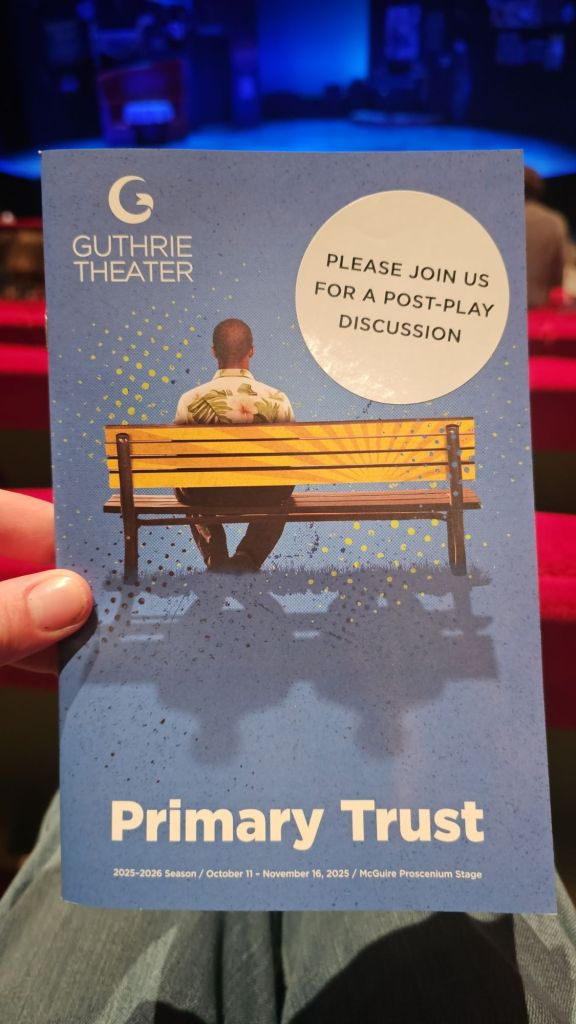
  • Although set in the 1990s, Primary Trust speaks directly to the “loneliness epidemic” of the modern era that so many have written and spoken about. Eboni Booth’s Pulitzer Prize-winning comedy-drama captures not only the pain of loneliness, but also how escaping it can create difficulties of its own.

    Kenneth (Bryce Michael Wood) is a man living in a suburb of Rochester, New York, and he’s been alone for so long he doesn’t recognize his own loneliness. His life consists of working at the same bookstore job he’s had since he was 18 and then spending his evenings drinking Mai Tais with his friend Bert (the always wonderful Will Sturdivant). Their relationship seems nice enough, but once its true nature comes to light, it becomes increasingly clear that Kenneth’s connection to Bert isn’t as healthy it seems. When he’s told his place of work is closing, Kenneth is forced to rethink his life and find another job. On the advice of friendly restaurant server Corria (Nubia Monks) he applies for a bank job, and while he takes to the work naturally, being surrounded by new people causes Kenneth to realize just how lonely he really is.

    Both star Bryce Michael Wood and director Marshall Jones III make their Guthrie debuts here, and they do terrific work managing the shifts in tone necessary to balance both the comedy and the sadness expressed in Eboni Booth’s script. It’s rather remarkable how well Wood is able to carry the show on his shoulders – his Kenneth is a true original. He’s socially awkward at the best of times, but not stereotypically so. It’s hard for him to make connections, but he’s not rude or standoff-ish towards others. It’s clear early on that Kenneth is in something of a state of arrested development, having never quite gotten over losing his mother at a young age and having to be raised in an orphanage. The things he has relied on at the play’s start- his job, drinks with Bert, the restaurant – are mostly crutches, and once he begins to realize that, the possible consequences begin to scare him even more. Other consequences aren’t touched on, through- the play doesn’t really dwell on the deeper implications of Kenneth’s daily drinking of Mai Tais, though. There’s no indication he’s an alcoholic, even though by his own estimation he’s been having his daily drinks for 15 years.

    The supporting cast is filled with local talent; not just Sturdivant, but also Nubia Brooks (last seen by me in last season’s The Nacirema Society) and Pearce Bunting (previously on this very stage in the Guthrie’s The Mousetrap). Brooks and Bunting both play multiple roles, and do so wonderfully. Brooks has a delightful scene where she plays both Corria and a male waiter unsuccessfully trying to flirt with her at the same time. Bunting makes his biggest impact as Kenneth’s boss at the bank, He gets a big laugh early on when he muses to Kenneth about having a brother who suffered brain damage before saying “You remind me of him!”, but that line also gets a tender call back later in the play when he shows that his relationship with his brother alllws him to understand Kenneth’s vulnerability, and wants to help him work through it.

    A Pulitzer Prize-winning play about a nice but very lonely man who drinks too much and needs to grow up makes me think a little bit of Harvey, but unlike in that classic play  there’s no real antagonist here, and I found that refreshing. Pretty much all of the characters are basically nice, and almost everyone who Kenneth encounters wants what’s best for him. The question is whether or not Kenneth is able to come to terms with his own issues and learn to trust other people. It’s a play that is smaller in scope than most put on at the Guthrie, but it still carries an impact. It makes you re-examine your own life experiences, and in between the laughs it can be almost painfully poignant.

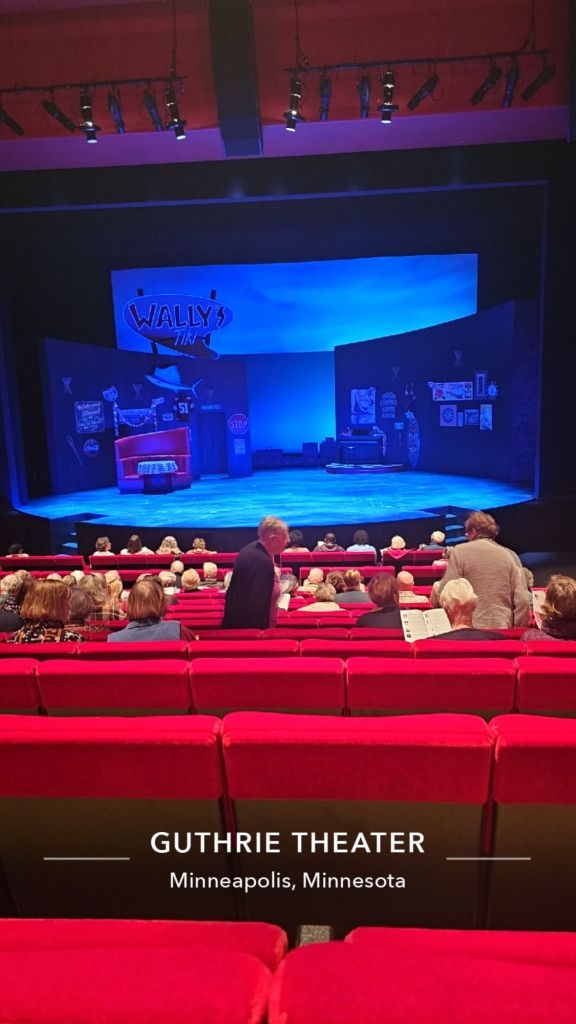
    PRIMARY TRUST runs at the Guthrie Theatre’s McGuire Proscenium Stage until November 16

  • Just in time for the start of Spooky Season, Brainerd Community Theatre has brought everybody’s favorite undead Romanian nobleman back to the stage. But this production is anything but a traditional take on the Count. This adaptation by Gordon Greemberg & Steve Rosen, directed by BCT stalwart Amy Borash, is a fast-paced farce that lampoons every element of Bram Stoker’s tale and then some.

    For a show as broad and silly as this, there’s a temptation to primarily judge it on the simplest of terms – did I laugh? Absolutely I laughed – there were hardly five minutes that went by in this 90-minute show without a chuckle, chortle, or belly laugh. But there’s more to appreciate here than just a series of jokes – there’s a ton of skill on display in their execution. Director Borash and her cast execute a smorgasbord of classic comedy tropes with a clever modern sensibility. What may be most impressive is how the cast, while being hilarious all the way through, never appear to be stretching for a joke. There’s no winking at the audience during this show, even if the material seems like it would invite it. All of the characters take the story deadly seriously, so the actors do as well, which inevitably makes the comedy all the more funny.

    The cast consists of five actors, four of whom play multiple parts. The only actor with a sole credit is Matt Hill as the title character. Hill plays the Count like an omnisexual 19th-century rock star.  He’s just out for a good time. Of course, his idea of a good time tends to involve more exsanguination than most.

    The Count also gets his kicks through manipulation and seduction, and he doesn’t discriminate – Lucy might be his primary target, but Dracula isn’t above cuddling with and smooching, either. Harker is played by Jacob Becker in an impressive balancing act. This version of Harker is a neurotic hypochondriac terrified of anything that might involve risk. That sort of characterization could easily become too much in the hands of the wrong actor, but Jacob Becker manages to keep him likeable, and when he finally gets the chance to cut loose near the show’s end, he clearly relishes it. As Lucy, Nancy Topete brings an appealing willfulness, making their character as strong and confident as Harker is wimpy and neurotic. Special recognition should go to Nicole Rothluetner and Noah Barnhart, both of whom spend most of the show in drag, but are savvy enough performers to not make that the main butt of the joke. The genderbending is just one of many avenues of comedy in this show, and the two of them play their respective roles with dignity – or at least the amount of dignity that can be afforded to Rothluetner playing a complete chauvinist who can’t possibly imagine the idea of a woman doctor or Barnhart as the affection-starved sister of Lucy who is desperate for male attention, no matter who gives it. The whole ensemble moves so smoothly between their roles (or less than smoothly, when a joke can be made out of it, as happens a few times to delightful effect) that it sometimes feels like a magic trick.

    The set design fits the fast pace of the show, with pieces rotating in the background to signify changes of location and only a few key props brought on and off as necessary. The costumes by Rachael Kline are predictably excellent, and the sound and lighting design bring the audience into the setting wonderfully.

    DRACULA: A COMEDY OF TERRORS runs until November 1st at the Chalberg Auditorium at Central Lakes College in Brainerd.

  • Hello, everybody. I figured I could use a spot to do more long-form writing on the various topics that spark my interest. And as is so often the case for me, I find myself joining a trend about a decade after it stopped being trendy.

    So welcome to my blog!

    Mostly, this will serve be a platform for my reviews and commentary on theatre. I see a lot of local and regional theatre in Minnesota, and especially in the rural part of the state where I live, there’s a dearth of writing about the arts in general and theatre in particular. I feel theatre of all stripes deserves criticism – it’s what helps it grow, both commercially and artistically.

    It won’t just be theatre commentary – I’ll probably spend time musing on my other interests along the way – cooking, film, what have you – but these days I find myself thinking and writing about theatre more than most other topics.

    At the same time I can’t pretend I’m not personally invested in the success of many of the groups I’ll be writing about, having worked with and for community theatres from Wadena and Staples to as far away as Brainerd and Little Falls. Many of the people in these productions are people I consider friends, and I know that will impact my objectivity.

    But criticism is not about objectivity – it never has been. It’s about sharing how a piece of art impacted you, and what your experience may mean for others. When people read reviews, they should be able to judge whether the thing being reviewed is worthwhile to them, whether the reviewer liked it, disliked it, or was ambivalent about it. If the artists are the seeds and the works are the plans, and audiences are the fertilizer, critics and commentators could be seen as the symbiotic insects who live on them. We need the ecosystem to keep going, and it’s in our interest to help it grow, even if our presence can be annoying.

    So welcome, friends and neighbors.  Let’s come together and help the arts grow.