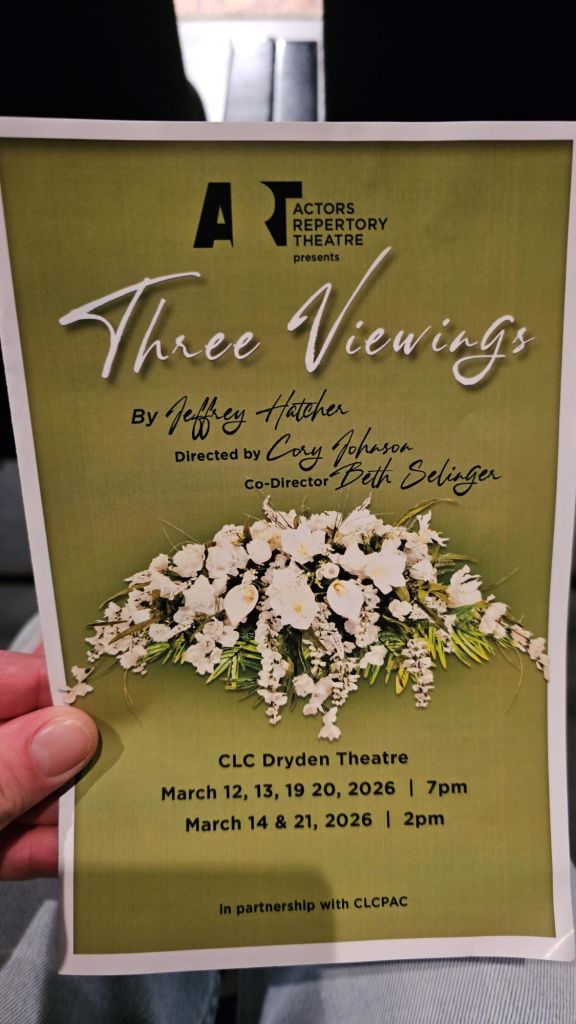
Funerals are always a whirlwind of emotion. People are gathered together surrounded by feelings of loss, memories of what was, and considerations of what might have been. It’s not unusual for people at a funeral parlor to run through the whole gamut of emotions, from grief to laughter to anger and everything in between. Jeffrey Hatcher’s Three Viewings, in production by Actor’s Repertory Theatre in Brainerd, is a series of monologues that capture those feelings in ways both familiar and unexpected, and it’s a very entertaining and moving show.
The first of the three monologues is “Tell-Tale”, told from the perspective of Emil (Patrick Spradlin), director of the funeral parlor where the show is set. Emil’s story is one of unrequited love, with him spending years pining after one of the real estate brokers who regularly attends funerals, searching for prospective clients. Emil can’t bring himself to talk about his feelings directly, so he tries to find other ways to attract her attention, hoping to find that one perfect moment to confess his love. A story like this is a tricky tonal balancing act, where the pathos of Emil’s longing is countered by his crossing of ethical or legal lines in his romantic pursuit. Thankfully, Spradlin realizes that Emil isn’t merely a pathetic schlub or a lonely romantic. He realizes that Emil’s behavior toes the line of stalker-ish, but also finds plenty of humor in Emil’s own complete lack of self-awareness to that – an almost throwaway line where Emil reveals that he is already married (about two-thirds of the way through his monologue, no less) gets a big laugh. It’s not always funny, though, and we also see glimpses of the possessiveness and anger that often come from a man who feels entitled to the love of a woman he can’t have. Some of the twists and turns in this story are a little predictable, and Sprandlin’s natural charm may make Emil into a more likeable character than intended, but throughout you really do get the sense that you’ve been given a glimpse into someone’s mind.

The second monologue, titled “Thief of Tears”, probably goes in the most unexpected directions of the three. It’s told by Mac (Mackenzie Pratt), a petty criminal whose MO is crashing funerals and then surreptitiously stealing jewelry from the dead in order to sell for profit. When she hears her wealthy grandmother has died, Mac sees it as a chance for her biggest score yet, although as we soon learn her motivation in this case is much more personal than profit-driven. Unlike Emil, whose character flaws are hidden by a lack of self-awareness, Mac is closer to a raw nerve, and as she interacts with family and acquaintances who ask her uncomfortable questions her only shield is denial. The most uncomfortable topic is that of her husband and children, none of whom appear to be in her life anymore. We eventually learn the truth about her family, and it’s more heartbreaking than you would ever expect, although it does also raise the question as to why so few people seem aware of it. Mackenzie Pratt plays Mac as someone so used to staying detached at funerals for people she never met that she seems fully unprepared for the tidal wave of emotion that comes from a funeral for a member of her own family – even one she didn’t particularly like. In seeing and feeling the grief of others, she’s finally able to begin processing the grief she’s never really been able to feel herself. There’s no easy resolution here – it’s hard to get a sense of where Mac is going or what she’s going to do next – but she has taken an important step, and maybe that’s all that matters.
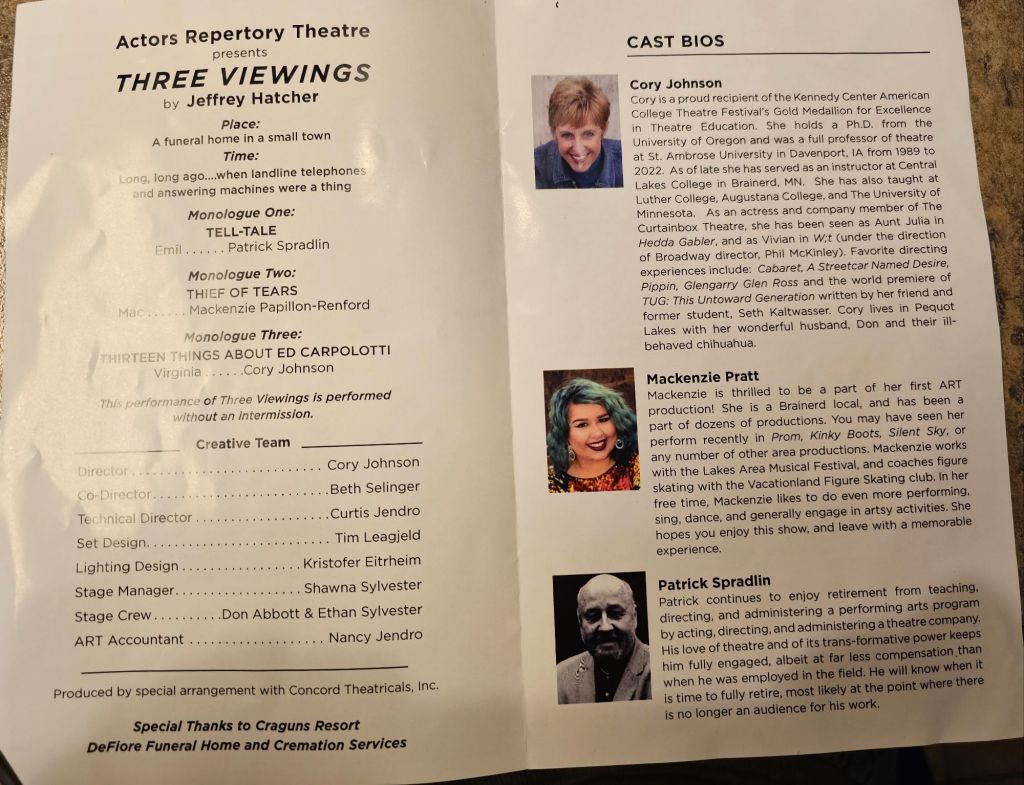
The final of the three monologues is probably the funniest – and undeniably the most stressful. “Thirteen Things About Ed Carpolotti” (performed by Cory Johnson, who also co-directed the show with Beth Selinger) is told from the perspective of Virginia, a recent widow who learns in the wake of her dearly departed husband Ed’s passing that there was a lot about him that she never knew. Namely, that his construction business was in trouble, which led him to make business deals with various people around town of various degrees of shadiness and legality. As a result, she finds herself responsible for paying back debts worth much more than she can afford, and if that’s not bad enough she soon receives a blackmail note demanding yet another payment or else the sender will release a letter detailing thirteen embarrassing things about Ed. This doesn’t sound very funny, I admit, but the juxtaposition of these high-stress situations with the innocence of Virginia’s character as she tries to process both what’s going on as well as her husband’s memory creates a lot of uncomfortable laughter. Johnson makes Virginia such an instantly loveable character that we can’t help but root for her, even if we can’t imagine how she could get out from under it all. I would never dream of telling you how this final story revolves, suffice to say it manages to build on every small detail of the story that came before it in a remarkably satisfying way.
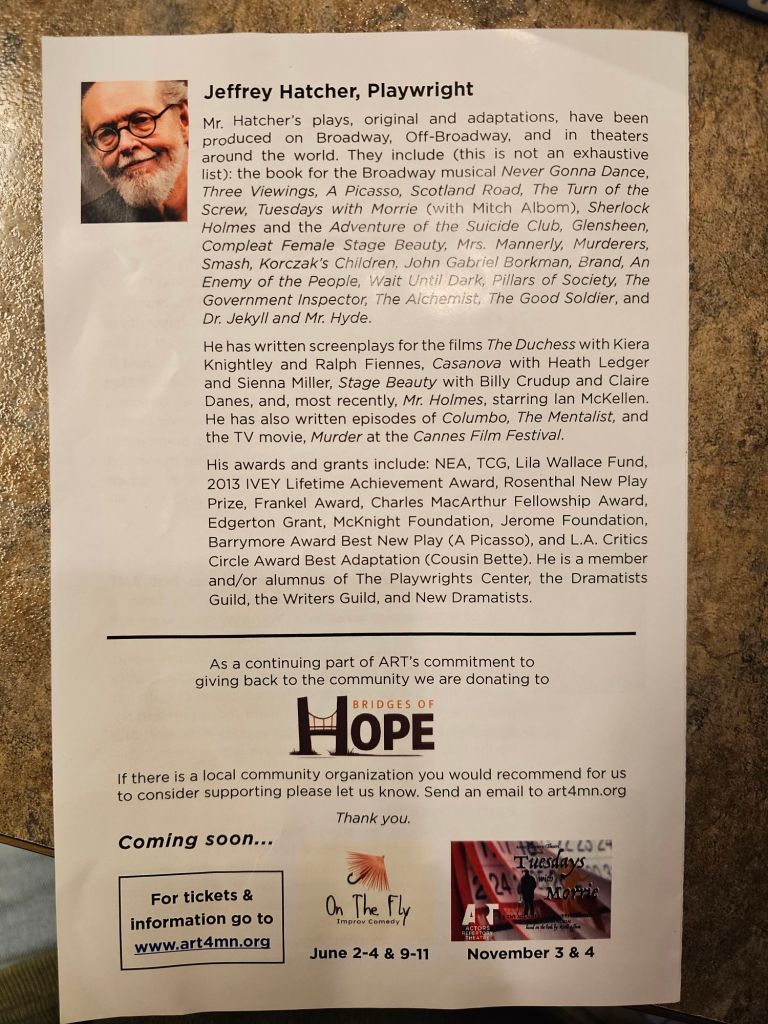
Hatcher’s writing is filled with little details like that. The three monologues may be self-contained stories, but they also contain small references to people and locations that remind you all of them are happening in the same town, and sometimes at the same time. You really get the sense that Hatcher has created a whole community in his imagination and Emil, Mac, and Virginia are just the three people he has plucked out of it to tell us their stories for this particular show. It’s a reminder that we all have stories – all of us are compelling characters in our own lives. Three Viewings is the sort of show that will lead you to look at other people just a little more closely, to wonder what their lives are like. That’s a sense of empathy that only theatre can deliver.
THREE VIEWINGS PLAYS AT THE DRYDEN THEATRE AT CENTRAL LAKES COLLEGE THROUGH MARCH 21
 Friends and Neighbors
Leave a comment