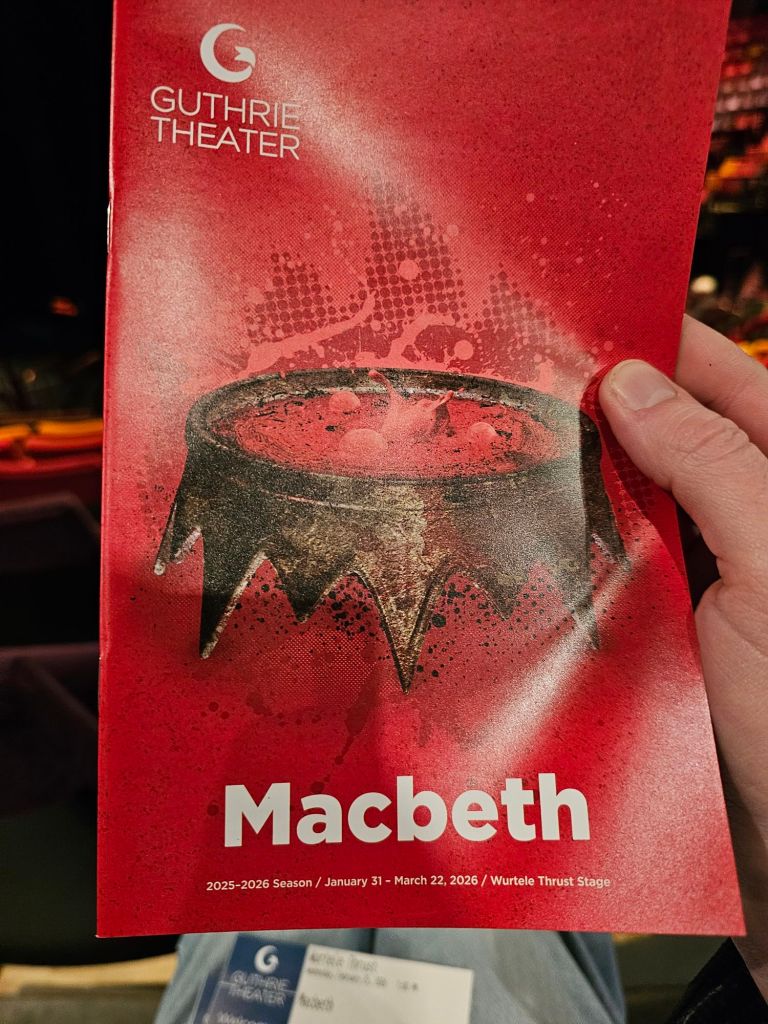
The Guthrie’s new production of William Shakespeare’s Macbeth is a tense thriller that showcases new dimensions to one of the Bard’s darkest tragedies. Cutting down Shakespeare’s text to less than two hours and running the show without an intermission enhances the overall sense of claustrophobia, but one also gets the sense that the cast might have done evem better had they had more of Shakespeare’s dialogue to work with.
Director Joe Dowling creates some incredibly striking stage images through his use of blocking and lighting. The opening sequence with the Weird Sisters, with its combination of music, fog, strobe-like lighting, and stylized choreography gets the show off to an appropriately moody start, and one early soliloquy by Macbeth has him speaking to his own shadow, looming over him as he tries to figure out whether to pursue his dark ambition. Most of the effects in this production are done through lighting and choreography, as unlike some previous Guthrie Shakespeare productions, this is done with a minimum of props and scenery. The locations are invoked by smoke, sound effects, and the occasional use of projections, while the cast is costumed mostly in black military garb. All of this serves Dowling’s vision that turns Macbeth into the center of a paranoid thriller as much as a tragedy.
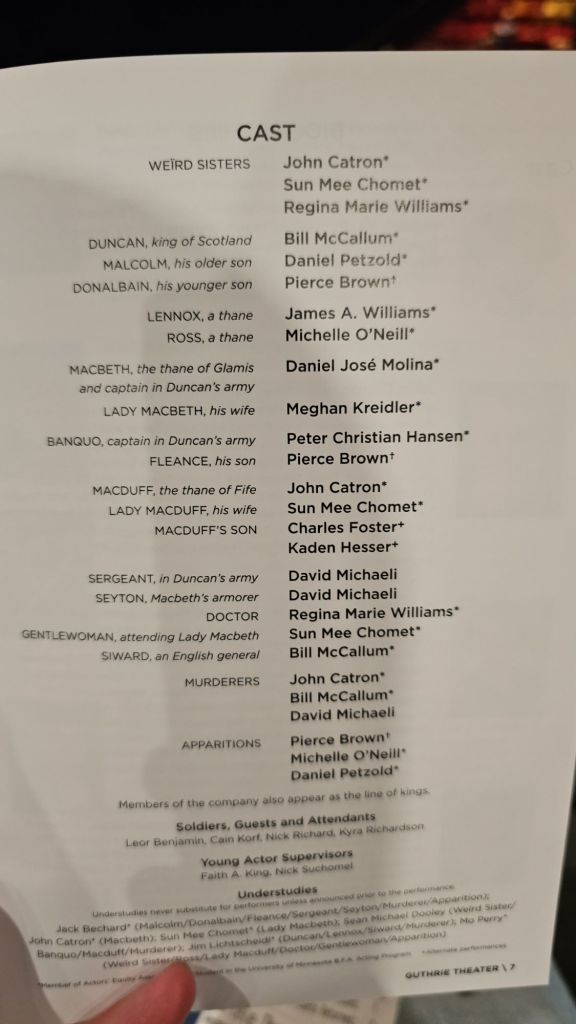
Daniel José Molina plays Macbeth, returning to the Guthrie several years after his remarkable work playing Prince Hal/Henry V in their production of Shakespeare’s Henriad. He brings a similar sense of youthful energy to Macbeth, but as the show progresses you also get the sense that despite the jovial attitude on display in the early scenes with his fellow soldiers, there was always a dark streak in him, and all that it took to push him into murder and tyranny was a little push.
In most productions of Macbeth the title character is portrayed as wracked by guilt both before and after murdering Duncan, only going through with it due to the encouragement and manipulation from his wife. Here, Macbeth seems tormented less by guilt than driven by a sense of self-preservation. Yes, he requires a push from Lady Macbeth (Meghan Kriedler, in an excellent performance), but once he’s killed Duncan and secured the crown for himself, he thinks little of ordering Banquo’s murder to preserve his own position or the murder of Macduff’s whole family simply to send a message. Indeed, he becomes so remorseless that Lady Macbeth herself is disturbed by what she sees. Meghan Kriedler’s Lady Macbeth is different from any other portrayal of the character I’ve seen – it’s easy to play the part like a devious villain, pushing Macbeth into regicide against his better judgment. But Kriedler finds something more complicated than that – you almost get the sense that she’s pushing him out of a twisted sense of love, encouraging to get him to follow through on ambitions she always knew he had. Later, as her husband descends into tyrannical madness, she seems truly frightened by him, and the guilt that drives her to suicide comes not just from her role in Duncan’s murder, but in realizing she played a role in the rise of a monster. This Macbeth isn’t the story of a tragic hero and his villainous wife – it’s a portrayal of a toxic marriage between two people matched in ambition and ruthlessness and the realization that the husband was a villain all along.
Molina and Kriedler are surrounded by a supporting cast full of local veteran actors – Bill McCallum makes for a warm and charismatic Duncan, Peter Christian Hansen plays Banquo, loyal to Macbeth until he realizes too late that their friendship is entirely one-sided, while Regina Marie Williams showcases her remarkable stage presence as the lead Weird Sister. Almost everybody in the supporting cast doubles or triples up on roles, and it’s a testament to their talent as performers and Joe Dowling’s direction that there is never a sense of confusion as to who is playing who.
One more thing that contrasts this production from previous Shakespeare plays I’ve seen at the Guthrie is the comparative lack of humor. Granted, Macbeth isn’t exactly one of the Bard’s funnier plays, but even in the productions of Hamlet and the history plays the Guthrie has put on in recent years the actors brought a lot of comedy out of the drama, sometimes in unexpected ways. You don’t get a lot of that here. There are occasional laughs, but the humor that exists is mostly deadpan, small bits of relief before the tension ratchets up again. This might be another result of the text being cut down for time purposes. What is clear, however, is that this vision of Macbeth is truly distinctive, a focused and striking production all the way through. It’s filled with unforgettable moments, from the opening invocation by the Weird Sisters, to a final stage image that will stick in my mind for a long time.
MACBETH runs at the Wurtele Thrust Stage at the Guthrie through March 22nd
 Friends and Neighbors
Leave a comment