As a vehicle for talented performers to cover a lot of Prince’s greatest songs, Purple Rain works. As a story about a young musician striving to define himself amongst sterility, unresolved emotional issues, and romantic pain the show is too unfocused and makes too many strange storytelling decisions to really succeed as a drama.
There are elements of the show that work but they are overshadowed by a book by the usually excellent Branden Jacobs-Jenkins (Tony winner for Appropriate and Pulitzer winner for Purpose) that has too many things on its mind to really be able to say anything about them. I had heard the show had issues with its book before I saw it, but I had assumed this was a similar issue that the also reliably talented playwright Lynn Nottage had when scripting MJ, but while that show had its drama compromised by an unwillingness to show its subject in anything but a sympathetic light, Purple Rain goes in the opposite direction – The Kid (the character is not Prince, it should be made clear) is such an impetuous jerk for so much of the show that it’s difficult to buy his redemption by the end.
The 1984 movie from which this show takes its inspiration had similar issues, but in that case it had Prince’s own charisma and screen presence to help counter some of the unlikeable elements of the character. The superstar admittedly was not much of an actor, so while he fared well at portraying the tortured artist side of The Kid, his romantic scenes opposite Apollonia felt mostly limp. Playing The Kid on stage, Kris Kollins (a musician and vocal artist making his professional acting debut) by contrast, has a very sweet romantic chemistry with Rachel Webb’s (best known for her role as Juliet in the national tour of & Juliet) Appolonia, and the early scenes between the two of them where they share their love of music and create songs together are some of the show’s highlights. Director Lilena Blain-Cruz and choreographer Ebony Williams incorporate ensemble dancers into a love scene set to “Electric Intercourse”, creating on stage the feeling of a montage of the characters singing, composing, and making love over the course of several days. It’s a beautiful sequence, and contains the sort of purely theatrical magic that is missing from the rest of the production.
These romantic scenes are so lovely that it makes it an even greater shame that most of the show’s story is devoted to the tortured artist side of The Kid, which Kollins isn’t able to handle as well. His efforts at playing that archetype come across instead as being more of a petulant, well… kid. Perhaps realizing that no actor could live up to Prince’s vibe, Jacobs-Jenkins’ book places an emphasis on the youth of its main cast, showing them as a group of young people trying to find their way in the world. How young they are isn’t specified (it’s implied they are college-aged) and that lack of specificity also applies to the setting. The show is set, as the movie was, at the First Avenue Club in Minneapolis, but the time period is a little bit nebulous. The characters have dialogue written with modern slang and sensibilities that wouldn’t fit with the film’s 1984 setting, but there’s no mention of the internet and a key plot point involves a TV special being filmed at the First Avenue, something that would seem outdated in a modern-day story. The First isn’t portrayed as being a jumping-off point for stars the way it was in the film, either – it’s just another music club, albiet one occasionally visited by talent scouts. A key point of conflict between The Kid and Appolonia is that she wants to go to New York to become a star, while he’s content to stay in Minneapolis and play his music at The First. This is one of the factors that leads to their split and Appolonia joining a girl group managed by The Kid’s professional rival Morris (Jared Howelton, giving an absolutely hilarious performance). That sense of double-betrayal sends The Kid into a spiral and he tries to channel his emotion into a series of uncomfortably raw live performances at The First, first his desire with “Beautiful Ones” and then his rage with “Darling Nikki”, and in neither case does he get the response he hopes for.
The live performances are another highlight of the show. The cast performs them beautifully, and the stagecraft is full of flashy lighting effects and energetic choreography. The audience around me often reacted as if they were at an actual concert. Rachel Webb gets some standout numbers at the lead of the Appolonia Six (which is later renamed The Six, a choice which distractingly made me think of the musical Six) and Jared Howelton, while not as magnetic as Morris Day in the film, is still a very funny and game performer who shows the audience why he’s a strong rival for The Kid.
The sets and costumes are all very well-crafted, illustrating the settings and heling define the characters. The audience gets a good laugh out of The Kid’s incredibly purple apartment, and there are a couple scenes where The Kid or Appolonia come out onto the performance stage wearing puffy fur coat whose purpose is seemingly only to create a shock when they take it off during their performance to show the skimpier outfit they have underneath.
For a lot of people, I imagine the musical performances and slick technical elements will be enough, but for a two-and-a-half hour long show with most tickets being sold at prices of several hundred dollars, I don’t think it’s unfair to expect a story worth caring about or characters with depth. There are attempts at exploring what happens when an artist beset by trauma alienates those who are trying to help him, but that’s dealt with primarily way of awkwardly expositional dialogue (especially in the early scenes). We also get flashbacks to the abusive relationship between The Kid’s parents through use of projections, and a complicated portrait of The Kid’s relationship with his father (Leon Addison-Brown). The fact that The Kid’s father becomes a key supporting character in the second act while his mother is left completely off-stage except for a single (projected) phone call is another odd choice – granted, the movie also humanized the father while downplaying the mother, but you’d expect a writer like Branden Jacobs-Jenkins, who is normally so good at exploring complicated family dynamics, to put in more effort at exploring that relationship beyond The Kid feeling conflicted about having to financially support his father while also being scared that his own life will mirror his father’s failures as a musician and husband.
The cast in general seems more comfortable with the comedic scenes, which offer welcome relief from the melodrama at the show’s core. Aside from the aforementioned Jared Howelton, Jaci Calderon, Christina Jones, and Lawrence Gilyard, Jr all give very funny supporting performances. Perhaps leaning more into the comedy would be a better idea for the show moving forward. It doesn’t have to be a full-blown parody, but playing the familiar tropes of the tortured but talented artist with a difficult family life with more self-awareness could make the story more entertaining and allow Kris Kollins to showcase more of the charm he shows in his early scenes with Rachel Webb. Purple Rain has potential, and Prince’s music remains undeniable, but I do think more work has to be done on the story and characters in order to make the production truly sing.
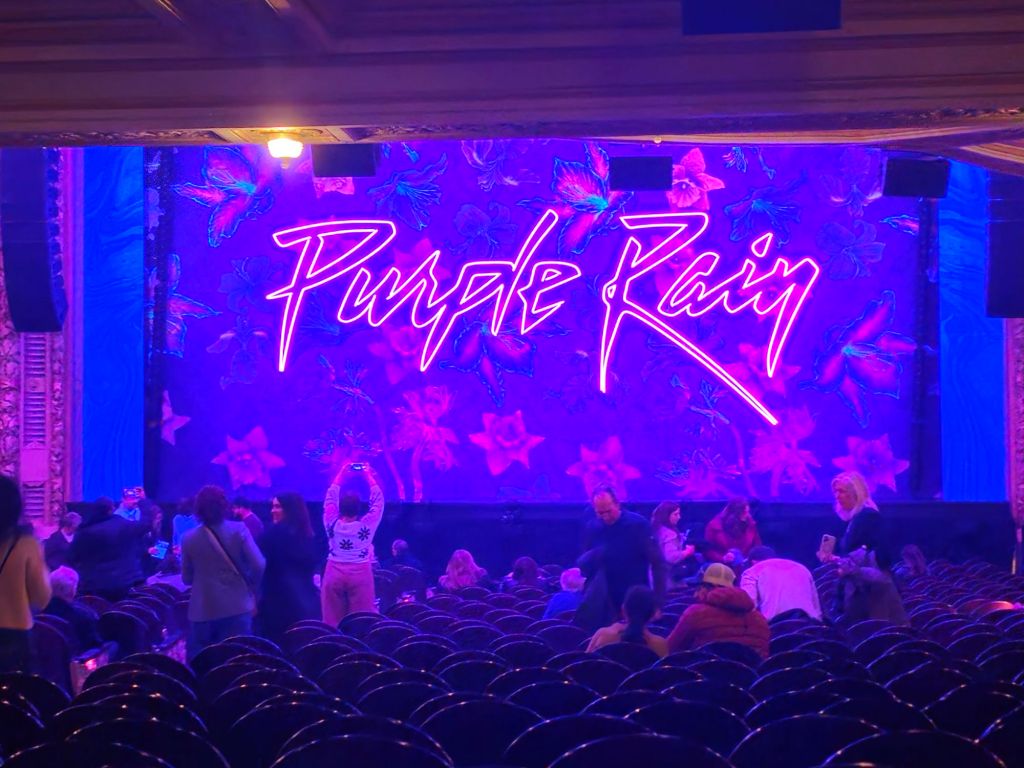
PURPLE RAIN plays at the State Theatre through November 23
 Friends and Neighbors
Leave a comment