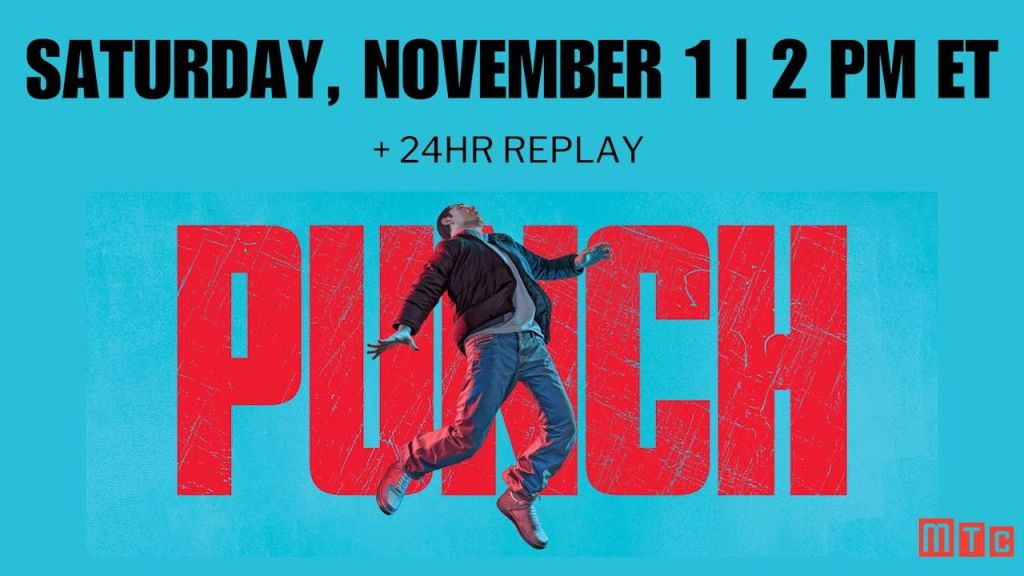
Through the League of Live Stream Theatre, the final week of Broadway performances of James Graham’s new play Punch were available to stream online, for about the price of your average ticket to the Guthrie. I decided to take advantage, and while the streaming experience itself had some hiccups, the play was a very satisfying and well-acted, if conventional, drama about redemption and connection.
Adapted from the memoir Right From Wrong by Jacob Dunne, Punch tells Jacob’s story – a young man growing up in a working-class neighborhood in Nottingham whose single mother does her best to support him, but both personal and social obstacles lead Jacob into an aimless life of crime. He begins to struggle in school, which leads to him being diagnosed with ADHD and autism. We then see that while the government offers some modest financial support to the family following of the diagnosis, the resources to help Jacob develop the coping skills to manage his symptoms simply don’t exist for his lower-class community. As a result, Jacob instead continues to struggle in school and eventually drops out entirely, finding instead work with the drug dealers who have always floated around his neighborhood.
For a young man who has difficulty processing emotions and making connections, gang life has a natural appeal. It’s constant stimulation – not just from the drugs they both take and deal, but the mere knowledge that you’re operating outside the law gives you a thrill. There’s a part where Jacob talks about having to find the exact right path to run through his neighborhood to avoid all of the CCTV cameras, and he compares it to living in a video game. The morality is also appealingly simple – you don’t talk to police, you stand by your friends, and any conflict that arises can be solved with a fight. Of course, Jacob soon discovers how fragile all of this high-risk, high-stimulation life on one ill-fated night when he joins his friends in a fight and ends up knocking someone out with a single punch, a punch which he soon learns proved fatal.
Jacob is played by Will Harrison, making a remarkable Broadway debut. Harrison, an American actor from upstate New York, has a flawless Nottingham accent and embodies Jacob’s physicality beautifully. Much of the first act involves Jacob telling his own story to the audience, and as director Adam Penford and playwright Graham move back and forth through time Harrison ably embodies Jacob’s state of mind. Through Harrson’s narration we see how excited he feels as he describes his actions in the moment and then as the scene shifts to him talking to a support group, his tone shifts completely, telling the same story but with a combination of awkwardness and embarrassment.
The heart of the story comes after the titular punch, when we are introduced to the parents of the young man killed by Jacob, Joan (Victoria Clark, recent Tony winner for Kimberly Akimbo) and David (Sam Robards). We see them cycle through the stages of grief – not believing it could happen to their son, rage and confusion when Jacob is sentenced to a relatively short prison sentence, etc. but the drama when in trying to process their own emotions, Joan comes up with an unconventional idea – why not try to connect with Jacob? This leads to the story following two tracks as it portrays Jacob’s attempts at reintigration and rehabilitation as well as Joan and David’s navigation of the UK’s Restorative Justice program, meant to create connections and find possible forgiveness between perpetrators and victims of crimes.
These scenes, leading up to an emotional conciliation between the three of them, give the play its greatest emotional impact but also highlight its greatest flaw. James Graham’s script, well-intentioned as it may be, often has the feel of a TV movie of the week, portraying the events in a simplistic and dramatically conventional manner and with heavy-handed dialogue that spells out exactly the points that the creators are trying to make. This is less apparent during the first act due to the high-energy direction from Adam Penford, but once things become more sedate in act two it really falls upon Harrison, Clark, and Robards (as well as the excellent ensemble) to make the dialogue ring true, and they mostly succeed. The exchanges between them start out awkward and difficult, but eventually they start to create a real connection, a deep bond that helps all of them move forward.
Primarily, though, it helps Jacob move forward. And to his credit he’s dedicated to his own rehabilitation and tries to use his own experience and example to serve as an advocate and help other people avoid falling into the same trap as he did. But the play’s focus on Jacob at its conclusion, while leaving Joan and David’s story at the question of forgiveness, is another example of the script’s dramatic simplicity. Near the end Jacob is preparing to give a TED talk, and in many ways that’s what the play feels like – a man sharing his own experiences and trying to find redemption through advocating for others, and while there is definite power there, you also get the sense that there is a more nuanced way for the story to have been be told.
Punch is produced by the Manhattan Theatre Club at the Samuel J. Friedkin theatre & can be streamed one more time starting Sunday, November 2 at 2pm EST though The League of Live Stream Theater
 Friends and Neighbors
Leave a comment