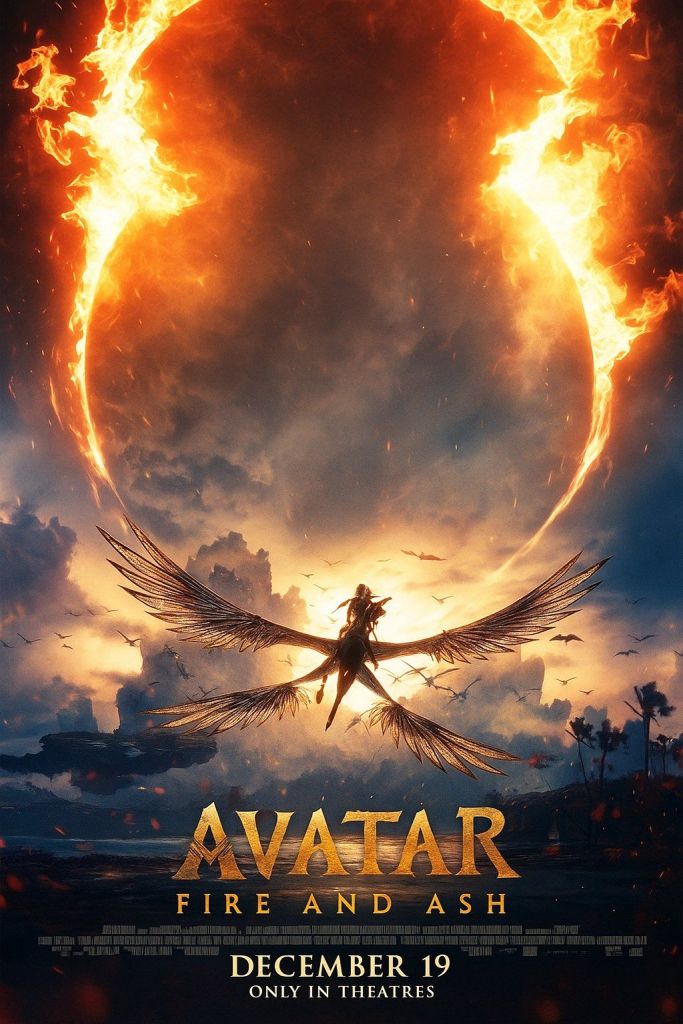
When the first Avatar movie was released, lots of people said it played like Star Wars for a new era. With Avatar: Fire and Ash, James Cameron shows the dynamic is much more akin to The Lord of the Rings, with an ever-expanding ensemble of characters working through their differences to find a way to overcome an existential threat.
The movie picks up immediately after the conclusion of Avatar: the Way of Water (another way in which the movie echoes The Lord of the Rings) and for much of the first act, it feels like Part 2 to TWOW‘s Part 1. Thankfully I rewatched TWOW last night, so I had the movie fresh in my memory, but for others, especially those for whom this is their first Avatar, it could be difficult to catch up. Jake Sully, his family, and their new community are still reeling from the massive battle that concluded TWOW, with the Sullys in particular mourning the loss of the oldest son Neteyam. His younger sibling Lo’ak (Britain Dalton) blames himself for Neteyam’s death, and during one heartbreaking argument we see that Jake blames him, too.
One thing that makes Fire and Ash distinctive compared to the other movies in the franchise is its greater focus on interpersonal conflicts. Protecting the family has always been at the core of Jake Sully’s drive, but a family constantly at war is sure to develop some issues, and we see some deep divides emerge. The cast does a terrific job of selling not just the conflicts but also the love that abides in spite of it. Zoe Saldaña is always good and is particularly effective here, which is nice considering she got the short end of the stick dramatically-speaking in TWOW. Sam Worthington has his best material yet and gives a genuinely great performance as Jake. The young actors (Britain Dalton, Jack Champion, Trinity Jo-Li Bliss, and Bailey Bass, alongside the not-young-but-still-terrific Sigourney Weaver) bring all of the energy and outsized emotions you’d expect from young people in such a situation. Jack Champion as Spider in particular finds himself at the center of some of the most emotionally wrenching moments of the franchise, and sells it wonderfully.
The scope of the Pandora mythos is once again expanded and deepened, this time by showing more sociological differences between the different Na’vi clans, including a trader class who tries to stay politically neutral in the conflict between the humans & Na’vi and most importantly, a militant bandit clan called the Mangkwan, or Ash People. They are led by Varang, a fearsome, sadistic, and creepily sexy Na’vi woman played by Oona Chaplain in a great performance showing that Oona inherited her grandfather’s knack for expressive physical acting. While most Na’vi tribes find unity over their faith in Pandora’s binding spirit Eywa, the Mangkwan reject Eywa completely, owing to a painful past when their previous forest home was engulfed in flame. When, as Varang puts it, Eywa didn’t come to help, they decided to worship the destructive power of the flames instead, becoming a fearsome and hedonistic tribe of bandits.
This lack of loyalty eventually leads Varang and her warriors into an unlikely alliance with Colonel Quaritch (Stephen Lang, stealing scenes the way he always does) who is still trying to hunt down Jake and Spider both for the Earth forces employing him and for personal reasons. This alliance becomes particularly important to Quaritch because his single-minded devoted to hunting them down becomes so single-minded that it brings him into conflict with his RDA superiors, who would prefer a more pragmatic approach because after all, they’re primarily there to make money and open war doesn’t help that very much. Lots of the returning human characters get more to do here, from Edie Falco as Quaritch’s military superior to Jermain Clement as a conflicted marine biologist. Even Giovanni Ribisi returns as the slimy business head with an amusing added twist where we find out that despite his position nobody respects him because he’s a nepo baby.
James Cameron continues to find new ways to wow us visually, and despite not being able to see the movie in 3D, it was still dazzling. Some of the visual themes are similar to TWOW, admittedly, but there plenty of moments that are simply beautiful to look at. These are the sorts of movies that you can lose yourself in, and with the extended runtime and confident pacing, it really does feel like you’re escaping to another world. And then there are the action sequences, some intense and frightening while others are exhilarating. The epic conclusion at the end features sequences within sequences as all of the characters have a role to play in the battle, and you never lose track of anybody for too long.
If you’re a fan of the Avatar franchise, Avatar: Fire and Ash delivers all of the gorgeous visuals, thrilling action, and resonant emotions you could ask for. It might feel like more of the same for some people, but if the same is still terrific, what’s there to complain about?
 Friends and Neighbors
Leave a comment